Entrepreneurship and Innovation
Experiential Education


What you will learn:
- The history of entrepreneurial thinking
- Characteristics of entrepreneurs
- How the entrepreneurial process works in business
- What social entrepreneurship is
- An introduction to innovation
According to www.businessdictionary.com, entrepreneurship is ‘the capacity and willingness to develop, organize and manage a business venture along with any of its risks in order to make a profit’.
But perhaps www.businessnewsdaily.com as captured the definition most succinctly where entrepreneurship is defined as follows:
At its core, it is a mindset – a way of thinking and acting. It is about imagining new ways to solve problems and create value.Add a quote source (optional)
I think this definition is the best definition as it is not just about trading and being in commerce but about adding benefit and value through a way of thinking, perhaps even to create a better world.


The History of Entrepreneurship
While you may think that entrepreneurship is a recent Phenomenon, there have been creative thinkers throughout history. Clever people have also been able to spot an opportunity and create something from an idea. The following article by Ryan Allis outlines the history of entrepreneurship from the beginnings of trade through to the start of the Industrial Age. Ryan Allis is an American technology entrepreneur and investor – you can see more about him by following this link.
This YouTube video also gives a short and fun outline of the history of entrepreneurship. You will need to be aware of spelling and grammatical errors (clearly resulting from translation challenges), and you can stop at 3min 29sec, but it is worth watching:
ENT04-2-History of Entrepreneurship | 4:49
What are the characteristics of entrepreneurs?
Entrepreneurs come in all shapes and sizes but they all tend to have the same characteristics of self-drive, passion, and creative intelligence.
Now have a look at the following YouTube video, which will provide you with an overview of the 15 main characteristics of effective entrepreneurs:
The 15 Characteristics of Effective Entrepreneurs | 6:20
What do you think are the three most important characteristics you believe entrepreneurs should have, and why?
Fun Activity #1
Are you an entrepreneur? The following link opens a page where you can answer 50 questions to determine your entrepreneurial score.
You don’t have to tell anyone else what your score is – it’s just for fun. It might be interesting to take this test again once you’ve finished this subject – I have a feeling the outcome might be different. You could also upload the completed response to your Pebblepad as an ‘artefact Moment’.
Follow this link to view The Lynda video site which has an excellent course entitled ‘Entrepreneurship Foundations’.
The Entrepreneurial Process
The entrepreneurial process begins with someone having an idea. Indeed, the most successful products and services have come about because someone saw something a bit differently; something no-one else had thought of; something that produced a need and made us go ‘why didn’t I think of that?’.
For instance who would have thought that there would be a need for a website where people can send messages to each other or post their thoughts – but that was how Facebook was born; or what is the point of sending an image to someone that almost immediately deletes itself? You would have to ask the founders of Snapchat. A message service whereby you are limited to 140 characters? What is this – 1994? The Twitter founders certainly thought so.
It also seems that most people wait for someone else to solve the problem, rather than do something about it themselves. The previous section highlights the characteristics of entrepreneurs, which might go some way to explaining those that do and those that don’t.
The start of the process is with an idea – that idea may be to do something that no-one has done before, it may not even be to make money; for example, Facebook was begun as a service to Harvard University by Mark Zuckerberg; see here.
Not all entrepreneurs or innovators are out to make huge amounts of money. There are many examples of innovations throughout history that had an impact on society, but did not set out as profitable enterprises.
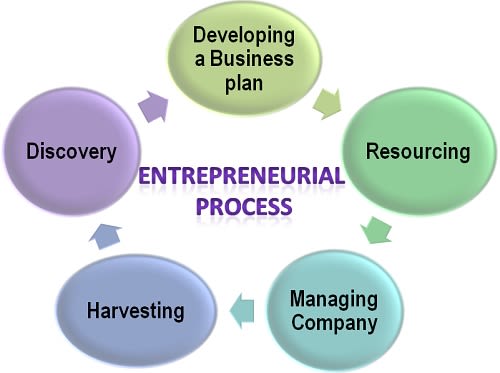
The idea is then developed into a business plan, resources are collected (loans, financiers, stakeholders), and a business is born to launch the product or service to the world.
The following diagram from www.businessjargon.com demonstrates the process.

Source: www.businessjargon.com
Source: www.businessjargon.com
Social Entrepreneurship
Solving a problem is the aim of most entrepreneurs – or what researchers have now come to call ‘Social Entrepreneurship’:
Social entrepreneurship is a process by which citizens build or transform institutions to advance solutions to social problems, such as poverty, illness, illiteracy, environmental destruction, human rights abuses and corruption, in order to make life better for many.
The following YouTube video will provide you with an overview of what social entrepreneurship is:
What is Social Entrepreneurship? | 2:02
Read this excellent article that also provides some more information on social entrepreneurship.
It is now assumed that business entrepreneurs are mostly concerned with making money – the profit motive is very strong! Social entrepreneurs are more concerned with their purpose, or the cause that they are trying to do something about. This does not mean that social entrepreneurs do not want to make money; after all, they need to find a way to pay for their social cause. The notion of ‘not-for-profit’ is evident here – which is, to make sufficient money to pay for all of the costs and then have some left over to continue to explore ways of increasing the services provided.
Have a look at this TED Talk entitled ‘Changing the world through Social Entrepreneurship’, which may even prompt thoughts of how you can create your own social programs to maybe change the world.
Changing the world through social entrepreneurship | 13:01
Innovation
We have looked at the history of entrepreneurship and how people become entrepreneurs through the discovery of some new innovation. It all starts with an idea that creative people follow through with when others may well abandon it (only for someone else to come up with the same idea some time later!).
Innovation therefore is all about creativity.
Why are some people so much more creative than others? Researchers believe the right hand side of the brain is used for creativeness (and the left side for analytical), therefore those who are creative may rely on the left hand side of the brain.
The Right/Left Brain Dominance Test (source) provides you with the opportunity to determine whether you are predominantly right-brained or left-brained.
This YouTube video is a fun way to test your brain. It has 12 illusions of pictures that can be seen in two ways, for which you are given 15 seconds each:
12 Illusions to test your brain | 6:46
Remember though that this is a simple fun test, do not worry if you can’t immediately see the images.
We all have had situations where we thought ‘why doesn’t someone come up with a product that will do x?’ Many ideas are born out of necessity – remember the saying first coined by Plato:
Necessity is the mother of invention
This YouTube video is a quick look at where you might find good ideas:
Where good ideas come from | 4:06
The following YouTube video provides another example of generating ideas:
Six Creative Ways To Brainstorm Ideas | 3:35
Activity #2
After watching the two videos on where you might find good ideas, note three of the best ways to generate ideas below . You could also upload it to Pebblepad as an artefact.
Conclusion
To recap: The history of entrepreneurship runs deep. In this module we have looked at the characteristics of entrepreneurs, what makes them effective, and how the process is undertaken.
We have also looked at the differences between ‘business’ entrepreneurship and ‘social’ entrepreneurship (although the differences may only be in degrees of differences according to whether you make money or not)
Activity #3
This website has a list of the suggested 40 greatest inventions of all time.
Starting with Fire and ending with the Quantam Computer – what would be your list of the top 5 innovations? I might suggest Facebook as a candidate – what about you?
You could also upload it to Pebblepad as an artefact.

Extra Reading
The following article describes the need for organisations to show leadership in terms of innovation in the workplace.
To demonstrate that entrepreneurship and innovation does not just belong to the private, for-profit sector, the OECD has published an excellent paper on the Core Skills for Public Sector Innovation.
Reference List
Allis, R, 2018, ‘The History of Entrepreneurship, <http://startupguide.com/world/the-history-of-entrepreneurship/>., retrieved 18/09/2018
Bornstein, D & Davis, S, 2010, Social entrepreneurship: what everyone needs to know, Oxford University Press.
Khajeheian, D 2017, ‘An introduction to entrepreneurship and innovation in media markets’, Global Media Journal–Canadian Edition, vol. 10 no. 1, pp. 1-8.
Johnson, W, 2014, Entrepreneurship Foundations, at: <https://www.lynda.com/Business-Skills-tutorials/Entrepreneurship-Fundamentals/162455-2.html >.
viewed 18/09/2018
Martin, R, & Osberg, S, 2007, Social Entrepreneurship: The case for Definition, Stanford Social Innovation Review, at: <https://ssir.org/articles/entry/social_entrepreneurship_the_case_for_definition>., viewed 18/09/2018
Sahadeo, C 2018, ‘Introduction to entrepreneurship’,. In Financial Literacy and Money Script, Palgrave Macmillan, Cham, pp. 175-205.
Acknowledgements: Many thanks also to René Kling from the University College for generously making his materials from ZAA204 ‘Entrepreneurship and Innovation in a Digital Age’ available to us to use in this introduction to Entrepreneurship and Innovation.