
Return to Work
Resources
for Workers
Topic 4 | Developing a Return to Work Plan


Working Through Stage 2: Determining your RTW arrangements
This section of the RTW plan (and RTW planning process) focuses on the arrangements which will be put in place to your return to working. This includes arrangements such as
- How much you will be working (eg the hours and days you will be working)
- Where you will be working (eg working from home, from your normal work site, from some other location)
- What you will be doing (the tasks and roles you will be performing)
- Arrangements to support your current state of health, and any treatment you are receiving (eg providing flexible start times so you can attend counselling appointments)
The RTW plan itself has four components:
- The work plan, of what work you will be doing, where, with whom, and when
- The safety plan, which details the supports you will need to feel and be safe to do that
- The communication plan, which details what information will be communicated to other people about the arrangements, and in what level of detail
- The implementation plan, which specifies how the other arrangements will all be put into place and by whom
That may seem like a lot to work out, but please know that:
The RTW process, and the RTW plan, will both work better if they bring together and reflect
- Your input about how you are feeling, what you feel capable of doing, and what supports you will need and benefit from
- Advice and guidance from your healthcare provider about what you are (and are not) currently capable of, and what supports you need
- Your manager’s about what options your organisation can provide
- Advice and guidance from other stakeholders such as your RTW coordinator, or rehabilitation counsellor, about how your return to work can be supported
The other important thing to remember is: planning for, and supporting a RTW work, is a dynamic process.
You and your manager will develop a plan based on what you both think will work to support you when you return to work. But neither of you will be able to anticipate everything that will be needed, because some of those needs will only become apparent as they arise.
Your support needs will probably change over time, and so may the types of support that the organisation can provide, so the plan will likely need changing and refining over time. Or you may find that the plan doesn't work as you both anticipated, and you need to start the planning process over again. That’s all OK!
The goal here is to use the plan, and the planning process, to provide the best match between your needs, and the organisation’s support, that can be achieved at any given time.
The best plan, and planning process, is going to be one which is flexible, responsive and open to change. Because that will give you, and your organisation, the best chance for a safe and successful return to work.
The figure below, developed by ReturnToWork, illustrates the overall process for developing the RTW plan.

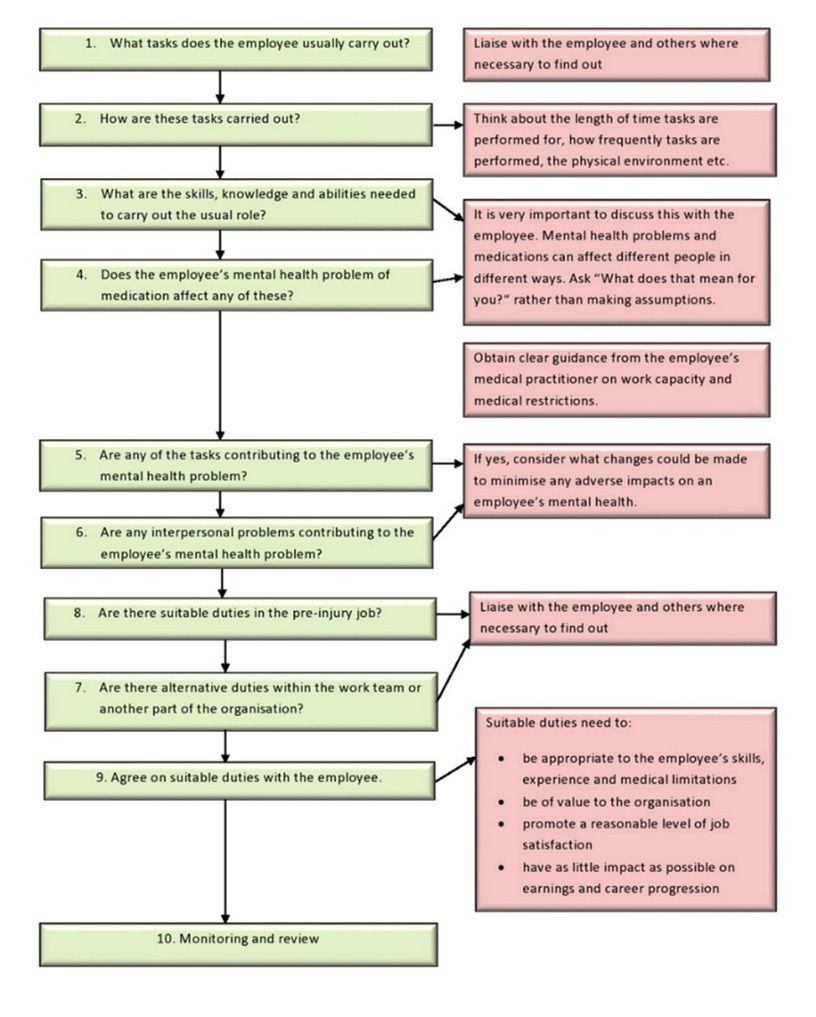


Developing the Work Plan
The focus of the entire RTW plan is to develop, and put in place, the workplace adjustments that you will need to give you the best chance of successfully and safely returning to work.
The overarching question which guides the whole planning process is:
What reasonable adjustments and accommodations do you need?
Arrangements put in place to support your return to working are known as ’reasonable adjustments’ or ’reasonable accommodations’. Reasonable adjustments are any changes made to a job, or the way it is performed, to help someone perform more effectively in the workplace. Adjustments might include
- flexible work arrangements (such as job rotations, or changing start and finish times)
- changing the tasks that have been allocated to a person (such as re-allocating them from working on one single demanding project to working on a number of smaller tasks)
- Changing the place, location or area in which they're working (such as a quieter work area, or work site at which they can work on a different range of tasks or roles)
It is actually a legal requirement for organisations to provide reasonable accommodations to people whose health affects their capacity to perform their job, which means that one of your manager’s legal responsibilities is to support you as a worker with mental ill- health by determining
- how the your health situation impacts your capacity to perform the inherent requirements of your job, and
- what supports the organisation can provide so you canmeet those requirements.
Those supports are the 'reasonable adjustments'.
a) What are you currently capable of doing?
To understand and work out the supports you will need, your manager will need to know as much as you are comfortable to tell them about
i. Your diagnosis, treatment and recovery support/rehabilitation arrangements
The more they understand about your current state of health, the better they will understand what support you need. Additionally, if you have been receiving worker's compensation, Tasmanian legislation requires that a RTW Plan for someone receiving worker’s compensation specify the diagnosis, treatment and/ or rehabilitation arrangements for their recovery.
ii. The impact of your symptoms, medication and or treatments
Even if some of those symptoms and impacts are only affecting you outside work time, it will still be helpful for them to know that this is occurring for you, and this is part of what you are dealing with and working through as you are returning to work.
I think it’s really important for a person [in a supervisory role], to have, some form of understanding of what the other person is going through, and what capabilities their brain has during a time of difficulty. You know, quite often, it’s you know, the brain fog is horrendous. And you just can’t concentrate properly. So understanding around that and reassurance that it’s ok if you don’t get that work done. Just do what you can within your limits, without sending yourself over the edge [is really important].”
iii) Impact of symptoms/medication etc on your capacity to work
You may find it helpful to think about - and discuss -your current capabilities in terms of
- Periods of time you are capable of working (hours, days, periods of time between breaks)
- Type of work environment you are capable working in (eg private space, space shared with one other person, open plan space)
- Locations you are capable of working in and from (eg home, usual work site, other work site)
- People you are capable of working with (team members, other members of the organisation)
- People they are capable of working with (clients, members of the public)
iv) Any other stresses or strains you are dealing with
If you have been dealing with – or are still dealing with - other stresses and strains while you have been away from work then these might also be affecting your mental health, resilience, or need for support. These might include
- financial worries about being away from work
- how your ill-health is affecting your family and home life
- how and when your health will improve
- if and when they will be able to return to their normal job
- the worker’s compensation process
Or other life challenges such unwell family members, bereavement or relationships difficulties or breakups.
If you don’t feel comfortable to talk about these with your manager, that’s ok! But it’s a good idea to discuss with your doctor or counsellor how they might also impact your return to work and the support you might need.
What are the goals for your RTW?
RTW is a journey. It’s going to be a series of small steps to best place you in a position to RTW. It is really important that during this time, you are setting small, achievable goals. This will help you feel less worried about the process. We have created a goal setting worksheet in your workbook for you to work through, to help you identify goals that can be done through small, medium or longer-term time frames. You may wish to speak with you doctor, partner and any other clinical supports about what your goals may be and how you can achieve them.
You can then work out with your employer what the specific goals and focus of your return to work plan might be. This would usually include the milestones the plan will focus on helping you to fully return to your previous work arrangements. However, if that is not possible, or it is not known at the current time if and when that will be possible, then the plan should specify what ‘successful’ RTW would entail for your current situation.
For example, if you are currently capable of
- Working a maximum of 10 hours per week
- Working from home only
- Undertaking administrative tasks but no client contact
Then the goals of the plan might be set around enabling you to safely and successfully work form home for then hours per week for the next 2 months undertaking administrative tasks.
a) How much you will be working
Most people returning to work from an absence related to depression and/ or anxiety will initially work reduced hours and then progressively increase the amount of time they work. For instance, they may come back 5 days a week but only a few hours a day, or they may work a full day but only a few days per week. They may also need to work shorter periods at a time and have more rest breaks.
Decisions about how much you will be working - overall and at any given time – go ‘hand in glove’ with decisions about what you will be doing because the tasks you are undertaking, and how much focus, concentration and energy they take, may affect how long you can work. Conversely, the amount of time you can work may influence what sorts of tasks are suitable for you to do. So decisions about how much
you will be working should be reviewed again once it is know what you will be doing, so that such adjustments can be made.
b) What you will be doing and where will you be working?
The next part of the RTW plan and planning process focuses on determining what duties would be suitable for you. What you and your manager are essentially working out in this stage is:
- Whether it will be suitable for you to return to your current role and work environment, with adjustments and accommodations provided,
and, if not,
- What other roles and work environments are more suitable for your current capabilities
Generally speaking, it is preferable for you to return to your existing roles, tasks and work environment so you are returning, as far as is currently possible, to your ‘normal’ work situation. This, in turn, means that you have to deal with as little additional change as possible, and can focus more on your recovery and return.
The exception to this is: when your depression or anxiety has been caused, or exacerbated, by work-related factors. These could include stressors such as the demands of your workload, traumas you have experienced in the course of doing your work, workplace conflicts, or having experienced bullying or harassment.
The exception to this is: when your depression or anxiety has been caused, or exacerbated, by work- related factors.
Arguably the most important thing is that you are not sent back into the same work environment which made you unwell in the first place. This may mean it is better and safer for you not to return – or return yet – to your existing role and work environment, and return instead to working in different conditions eg working in a different team.


Identifying suitable duties
There are 3 steps to determining whether it will be suitable for you to return to your current role and work environment:
1. Identify the inherent or core requirements of your job
The inherent or core requirements of your job are the fundamental aspects of the job that can't be changed or altered => what the job inherently is or entails. These include the key tasks that you must be able to undertake and perform, and the key skills you must have to perform it.
2. Determine which aspects of the job might need to be adjusted
The next step is determining what aspects of your job, and work arrangements need to be adjusted in light of your state of health. You and your manager can do this by working out
- Which of core aspects of your job you can currently do as they are
- Which aspects you can currently do with some support / adjustments
- Which aspects you can’t currently do
This will help demonstrate whether you are currently capable of doing your current role, or whether you may need to return in a different role.
Generally speaking, there are four main scenarios for returning to working:
| Same job Same team /work unit/department |
Different job Same team /work unit/department |
| Same role Different team /work unit/department |
Different job Different team /work unit/department |
So when you are working out with your manager what work you can do, they should also consider the options for you to potentially return to working into a different role or work team if those might provide a better fit with your current capabilities and support needs. Those options pose other trade-offs and support needs, which we discuss in the section about developing the Safety Plan.
3. Identify the reasonable adjustments that can be provided to support you
When you and your manager are identifying the adjustments that could be needed and provided, it’s important to consider, and work through this for
- Your current role (if it is an option for you to return to that)
- Any other roles or duties you may potentially return to instead
This is because the nature of the work you are doing, and hence the support you need to do it, will depend on the actual work you will be undertaking. Likewise, the suitability of you doing particular work may depend on the adjustments that can -or can’t – be provided. So its very important to work out the ‘total package’ of
- What the tasks and duties would be
- What the adjustments will be
For each option so you and they can make a fully informed decision about which scenario is MOST suitable for your situation.
Types of accommodations
Flexible work options
Providing flexibility (variability with days worked or start/finish times)
Working from home.
Part-time work
Working from a quieter location (alternative office/working location)
Working from a more private location (own location, or privacy screen)
Changing responsibilities or tasks (eg admin tasks instead of face-to-face interactions)
Support for difficulties with thinking processes
Provide a diary or electronic organizer to write down deadlines
Use diagrams, aids or models as guides for how to perform a task
Provide a go-to person so you can discuss progress or issues
Highlight tasks that you'd like to prioritize
Provide a keyboard overlay to remember shortcuts/functions
Write down instructions
Support for difficulties with organising and planning
Develop a written plan of action with achievable tasks and set times for completion dates or times
Allowing extra time to complete tasks
Reminders of important deadlines through informal emails
Setting up informal meetings to discuss progress (being aware of body language and ensuring it doesn't seem like performance management).
Organising a mentor with similar skills, knowledges and experience to support
Providing access to an external provider (EAP) for support
Support for difficulties with social interactions
Allowing work from home for a short period of time
Not making social interactions mandatory
Allow personal calls during work hours to external support people (partner, doctor, etc)
If regular meetings are required, making these less social
Relocating to a more private space with less social interaction.
Support for Difficulties with energy levels and fatigue
reducing writing tasks by enabling recording of meetings
introducing assistive technology to reduce keyboard activity and reading from a computer screen (e.g. speech recognition software allows a person to use speech to access all functions of the computer)
providing training to the worker about accessible computer functions, such as use of speech to text and text to speech
reducing physical activities by identifying less physically demanding tasks
providing short breaks to relieve any physical or mental fatigue
Support for Required absences from work
providing limited paid time off to attend medical appointments during work time
time-in-lieu arrangement for long appointments
organise medical appointments on a quieter day of the week, grouping appointments together or booking appointments at the start or end of the working day to minimise the impact on the workplace
providing a limited number of cab vouchers to support attendance at medical appointments.
Support for difficulties with emotions and anxiousness
Allowing flexible timing of breaks to enable stress management techniques.
Support to walk away or step away from frustrating situations
Demonstrating more positive responses to frustrations at work.
Accessing immediate support if you’re concerned about hurting yourself or others
Effects of reasonable adjustments on pay and entitlements
Your manager should also advise you about how potential return to work arrangements might affect your pay or other entitlements so you can ‘sense-check’ how workable the arrangements are, and for how long they can be sustained. It will also help you avoid being caught out by any unanticipated consequences, and know whether the arrangements will be workable to implement.
Developing the Safety Plan
The safety plan details the additional arrangements or supporting your safe return to work, beyond those needed to ensure the work duties you have align with – and aren’t too much for - your current capabilities.
1) Identifying and managing safety risks
When you are planning to return to work, it is crucial to consider whether there are any factors in your workplace that may pose risks to you returning to work safely and successfully.
This includes factors that may pose a physical risk, and those which pose a psychological risk. You can find more information about psychosocial hazards here:
Comcare | Psychosocial hazards
What’s important to consider is - how safe you feel is just as important as how safe you are. For example, if you feel unsafe about being around a particular person in the workplace then you may feel very unsafe all the time, even if the actual amount of time you are around that person is relatively small.
Types of risk to consider, assess and manage
Risks posed by your current work environment
If you are returning to your usual tasks, work team, and work location:
Consider the risks posed by
- The risk and strain posed by the tasks you will or usually, perform
- Learning and performing any new or different task
- Your physical work environment (eg noise, physical layout)
- Your social environment (eg interactions with coworkers, managers, staff who report to you, clients or customers, and with members of the public, if that is part of your role).
- What was occurring in the workplace at the time that you went on leave. There are a number of issues to think about here, and it’s important because any of them could have affected or be affecting
- how you felt at the time you went off work
- how you may be feeling about coming back to work
- how safely and successfully you are able to come back into the workplace and feel supported
Social
- The organisational culture
- How does it feel to be at work?
- Are you happy to go to work, or do you feel sad on Sunday, thinking about a Monday?
- Interpersonal relationships
- Do you get along with the people you work with? Or is there conflict?
- Competing home and work environments.
- Are you thinking about all the things you have to worry about at home whilst you're at work?
Systems/Ways of Working
- Content or demands of work.
- Is there too much for you to do?
- Workload, work pace, work schedule or work hours.
- How long are you working for? Is it fast paced and stressful or can you slow it down?
- Control over work.
- Can you decide what is prioritised? Can you make decisions about how you perform your role?
- Communication in the workplace.
- How does it happen? Is there a LOT (constant dinging of Teams, emails, Zoom meetings, calls that constantly fight for your attention?)
Risks posed by a new work environment
If you are going to be working with different tasks, work team and / or work location:
Consider the risks posed by
- The tasks you will be undertaking (including risks associated with having to learn new tasks and ways of doing them)
- The new physical environment
- The new psychosocial environment. If you're going to work with new people you don’t know, and who don’t know you, and you may also be expected to interact with those people in ways which are new and different to what you have done in your current role. So it’s important to explore how you might feel about that, whether those scenarios feel like they might help and or harm your state of health, and if those feel like better or worse options than returning to your current role and team.
- The additional risks and strain associated with having to adjust to a new work situation.
Risks posed by medication
If you are taking medication to treat and support your mental il-health, there may also be a potential risk that medication may affect your capacity to perform work safely, and hence pose a potential risk to yourself and others.
2) Support if you become unwell at work or aren’t coping
Planning your return to work should also include developing a plan about what to do if your health worsens. This should ideally include information/ details about
- What signs (eg behaviours, mood states) would tell you – and possibly other people around you that you are becoming distressed, not coping, or need support
- What actions you and other people can take if that occurs
- When it would be appropriate to contact someone – such as a doctor or family member – if you become unwell at work,
- Who that person should be and how to reach them if necessary
[The staff member] I’m working with now, her persona has changed immensely through the adversity that she has been through....she’s just that far away from falling off the edge at times. So I’m, you know, I’m always opening my ears to what she’s saying and analysing in my own mind where she’s at today."


Developing the communication plan
Who (if anyone) to tell and what to tell them
In the process of planning your return to work, it is VITAL that you discuss with your manager how you would like them to explain your absence and what information you give permission to share about your health situation. So you'll need to work out with them- and you will need to explicitly consent to -
- Whether they should tell people in the workplace that you have been on leave because of a mental health issue
- Whether they can tell people in the workplace what the mental health issue was, for instance that you have been experiencing depression.
BeyondBlue has support resources and a decision tool you can use to help you decide what (if anything) you want to tell people in your workplace about your mental health:
BeyondBlue | Working with poor mental health
Even if you do agree that they can share that information with other people in the workplace, it's important to carefully consider
- why you would do so,
- what benefit that will likely have, and
- any potential risks that that may pose to you.
It's particularly important to consider whether other people in the workplace have previously demonstrated that they have an accurate and supportive understanding of mental health issues, and whether they're likely to treat that information respectfully and sympathetically.
How other workplace members should help if you become unwell
You and your manager should also consider, and plan for, what other staff may need to know in order to be able to support your return to work. This might include
- What signs or behaviours might indicate you are unwell and need support
- What to do if they observe those signs or behaviours, or they observe you becoming distressed
- That you might need different forms or levels of support over time
- How they can reduce stressors and factors that can undermine your return to work
- How they can support your recovery and assist a safe and successful return to work
So again, a key question here would be who REALLY needs to know. For instance, if you are going to have a workplace buddy to support your return to work, then it may be that the buddy needs to be told this information but other members of the team or department might not. Alternatively, if you are going to be working with a number of different people, then it may be more appropriate for more people to be told.
But again, the key consideration here is - who you feel safe about knowing this. If you feel unsafe about people around you knowing these things, then the best option may be to tell others in the workplace the circumstances under which they should contact your manager who can then arrange support for you.
How workplace accommodations will be communicated
You should also discuss with your manager how other people might respond when accommodations are put in place, and how they and you could prepare to respond to any questions or speculation about that. For example if you are going to be working at a different workstation or working different hours than you previously did, other people in the workplace might ask why this is occurring, and may even begin to speculate or gossip about this. So it's important that both you and your manager have both thought about how other people might respond to and interpret those adjustments.
Working out in advance what you might say and how you might say it will help both of you feel more comfortable and confident about handling that situation.
Additionally, working out, together, how you will respond to those kinds of questions and comments, will help you also work out whether backup responses might also be needed. For instance, you might plan to say simply that “I'm going to be working part time for a while”, and then realise that other people in the workplace might respond by asking
- Why that is the case, or
- The duration of that arrangement
So you might then also plan that you would respond to such questions by saying that these arrangements are related to a health issue, so they will be in place for as long as is required, and you can't predict right now how long that will be.


Developing the Implementation Plan
The final part of the RTW plan is about putting the arrangements in place and documenting the steps needed for your return to work. This includes:
- Defining tasks, assigning responsibilities, setting timeframes, and establishing deadlines to ensure readiness for your return.
- Identifying the tasks you'll handle, the resources and support required, as well as your manager's tasks and their needs for support.
- Collaborating to determine if additional input or assistance is necessary from external sources like medical professionals or HR.
- Specifying processes that should be used to handle any disputes about what should be occurring with your return to work.
The most important thing is that you work these details out together, so that you both know what is to be done, who is to do it , and when.
The implementation plan should outline checks to confirm that accommodations and support systems are in place before your return. This should include a check-in meeting with your manager before you commence work so you can discuss together:
- Review the plan's completion status and set timelines for pending tasks.
- Discuss backup plans if needed.
- Address your feelings about returning to work and identify any additional support required.
- Plan for your first day, including arrangements to connect with a workplace support contact or buddy.
It is a good idea to visit your workplace before starting to reacquaint yourself with the environment, colleagues, and to mentally prepare for your return.
So on my first day back, I came in feeling nervous like, “what's happened? was changed? I haven't accessed my emails like. Who's around? Who's quit? Who’s been fired?” I went to down to where I told I was being sitting and admin told me, “yeah, we've set up your IT, like all your desk where you used to be” . And then I spoke to the team leader, and they said “no, I don't know anything about you coming into the team”, and neither did the other team leader. So they finally found me a team to join but then there wasn't any space in with that team, I had to go and sit somewhere else. And I was starting to get really upset and just feel really unvalued, like a feeling of rejection.”
You and your manager should discuss how you'd prefer to be welcomed into or back to the work environment.
Consider talking to your manager about how you'd like your first day to be handled.
If your workplace typically acknowledges returns from leave during morning tea or through other gestures, let your manager know if you're comfortable with a similar acknowledgment for your return. You can also let them know if you are comfortable for people to ask you how you are or about your leave, or if you would prefer your manager to ask them not to do that.
Reviewing RTW arrangements
This part of the RTW plan should address and document arrangements for reviewing your RTW to determine whether:
- The RTW arrangements are working as anticipated.
- they are effectively supporting you in your work and recovery.
- your support needs have changed.
- different supports and arrangements are needed.
Recovering from mental health challenges can involve fluctuations, good and challenging days, and varying emotions, especially during the initial return to work. This phase can be taxing due to the mental, physical, and emotional adjustments required to resume work routines and reengaging with the work environment. So it's also quite normal for people to feel a range of different emotions, and more tired, as they go through the first days and weeks of returning to work.
It's important for both you and your manager to understand that your energy levels and capabilities might vary a lot when you first return to work, and that you both factor that into your expectations of what you can do and what help you might need.
For this reason regular check-ins between you and your manager are essential. Scheduled check-ins, such as on the first day or week, are beneficial, but there should also be provisions for contacting your manager or another workplace support person between scheduled meetings if required.
The plan should also specify the date(s) for reviewing the plan so that
- Everyone concerned knows when that will be undertaken and
- The plan complies with Tasmanian legislation that requires that RTW plans for people receiving workers compensation include the review date for the plan
Once the RTW plan has been documented, you might like to take this back to your doctor/other support people - legal advisor etc. to get their perspectives and advice, particularly if the arrangements that were negotiated differed from their recommendations.
References
Australian Human Rights Commission. (2010). Workers with mental illness: A practical guide for managers. Australian Human Rights Commission.
Beyond Blue. (n.d.). Supporting the return to work of employees with depression or anxiety. Melbourne: Beyond Blue.
Return to Work. (2023a). Return to work: Topics for employees. Retrieved from https://returntowork.workplacementalhealth.net.au/
Return to Work. (2023b). Managing relapse template. Retrieved from https://returntowork.workplacementalhealth.net.au/tools-downloads/
Safe Work Australia. (2023). Developing a return to work plan: Guide and template. Retrieved from https://www.safeworkaustralia.gov.au/system/files/documents/2023-06/developing-a-return-to-work-plan-guide-and-template_0.pdf
WorkCover Tasmania. (2023). Guideline number: G-020 – Guideline for preparing return to work plans and injury management plans. Retrieved from https://worksafe.tas.gov.au/__data/assets/pdf_file/0007/604627/G-020-RTW-and-IM-plans.pdf
WorkCover Tasmania. (2024). Information sheet number: IS-016 – Preparing return to work plans. Retrieved from https://worksafe.tas.gov.au/__data/assets/pdf_file/0009/654267/RTW-plans.pdf
 Built with Shorthand