
Referencing Examples - APA7
Experiential Education


Objectives
By undertaking this module you will be more familiar with the following as you access other people's knowledge and ideas and utilise them in your own work:
- The necessity of referencing when you refer to other people's knowledge and ideas
- What referencing styles are
- University College’s preferred referencing style (APA7)
- How to create in-text citations and Reference List entries for each source type


Introduction
At University College you will be building on your own skills and knowledge, and learning new skills and knowledge. This new knowledge will come from many different sources: the Internet, websites and documents within websites (including the University College online modules in MyLO), books and other print media, radio and television, your teachers, tutors and coaches, and your peers.
Part of your learning journey will include doing assignments and other assessment tasks that signpost your progress. These might include such tasks as presentations, reports, and reflections. While preparing or presenting your assessment work, you will be drawing on the words, knowledge and ideas expressed by others.
Every time you do so, you must acknowledge (that is, make a clear note of in your work) from where you obtained those words, that knowledge and those ideas. That is called ‘referencing’, because you are ‘referring’ back to the source.
It will always be assumed that what you present in assignments are your own words, knowledge or ideas. This means that you need to make it clear when what you present is not yours, otherwise you might be committing plagiarism. This can be considered as fraud, which is a breach of academic integrity.
Here are sites you will find useful:
Academic Integrity Unit
If you have not completed the mandatory University of Tasmania online unit on Academic Integrity, we strongly suggest that you do so. Here is the link:
The Academic Integrity unit provides a deeper understanding of what academic integrity is, and what might constitute a breach. It takes approximately half an hour to do.
Referencing Module
For the ‘whys and wherefores’ of referencing, please see the Referencing module. Here is the link:
This module explains how to acknowledge it correctly each time that you utilise other people's words, knowledge or ideas in your own work, whether you use them as illustration, or as part of your argument.
Each type of source has slightly different referencing requirements. This module provides a reference example for most types of source, from online videos to academic journals, from books to personal communications.
Before you start...
Try this quick quiz. Tick the boxes where you believe a reference needs to be used:
Answers:
Most of the items should have been ticked. The only ones that do not need referencing are items 5 and 6.

What is a referencing style, and which one should I use?
A ‘referencing style’ is a standardised protocol for how referencing is done, to ensure that anyone, anywhere, can know exactly the source of the words, knowledge or ideas. Think of the protocol as a pattern or formula.
At University College, we utilise the APA7 (preferred) or UTAS Harvard style (only until 2025).
SOME HANDY LINKS
APA7 Basics
What is the key information to collect from your sources?
- Author: Who is responsible for this work?
- Date: When was this work published?
- Title: What is this work called?
- Source: Where can I retrieve this work?
(APA Style, 2022)

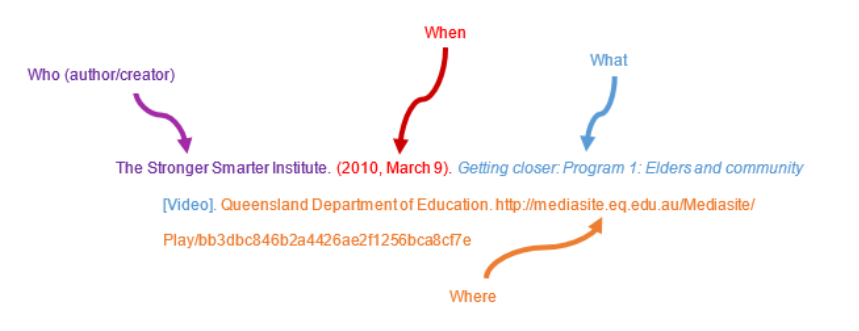
(University of Southern Queensland, n.d.)
(University of Southern Queensland, n.d.)
What if I am missing information, like the date?
If there is no date or year of publication, use the abbreviation n.d. (which means no date). For example an in-text citation would look like this: (World Health Organisation, n.d.)
If there is no author then move the title of the text to the author’s position of the reference. For example an in-text citation would look like this: (World Health Organisation: Mental Health Fact, 2012)
What are ‘the rules’ around multiple authors?
- Two Authors: Always cite both names every time the reference occurs. Example: (Smith & Jones, 2020).
- Three or More Authors: Cite only the last name of the first author followed by "et al." and the year for all in-text citations, including the first citation. Example: (Smith et al., 2020).
- Different Works Same First Author and Year: If you are citing works published by the same first author in the same year, the APA style differentiates them with a letter system in both the in-text citations and the reference list. Example: (Smith et al., 2020a) and (Smith et al., 2020b).
What is a DOI?
In the examples below you might read about a DOI. A DOI, or Digital Object Identifier, is a unique alphanumeric string assigned to a digital object, such as a journal article, report, or any other piece of academic literature. Much like a fingerprint for every piece of text. In APA 7 citation style, if a DOI is available for a journal article or other publication, it should be included in the reference list entry. The format typically used is "https://doi.org/[insert DOI here]".
Does APA7 have any unique format requirements?
- Order: References should be listed in alphabetical order by the surname of the first author or by title if no author is provided.
- Date: The year of publication is placed in parentheses directly after the author's name. If available, include the month and day for periodicals.
- Titles: Book and article titles should be in sentence case (only the first word of the title, the first word after a colon or dash, and proper nouns are capitalized). Journal titles and the names of publishers should be in title case and italicized.
- DOI and URLs: If available, include a DOI for journal articles. If a DOI is not available, include a URL. DOIs should be formatted as links (e.g., https://doi.org/xxxxx).
- Hanging Indent: Each reference should have a hanging indent, where the first line is flush left, and subsequent lines are indented.


How the examples are set out
With each source type, we provide:
- An example of how the words, information or idea might be utilised in a sentence, and how the relevant in-text citation would appear
- A list of the descriptive elements that need to appear in the Reference List entry (unless no entry is required)
- The correct reference for the example as it would appear in a Reference List
Along the way, we also provide some:
- Helpful hints about aspects of citing and referencing. Some of the hints might apply to that source type only; others apply generally
- Opportunities for you to practise your new knowledge about referencing
If you follow these examples, and remember to put capital letters, italics/plain text, single inverted commas, commas, full stops, spaces, page number/s and other information and punctuation precisely as they are shown, you can’t go too wrong. The key is consistency.


Examples of types of source, usage, in-text citations and references
Generative Artificial Intelligence Tools (e.g. ChatGPT, Craiyon)
The results of Generative Artificial Intelligence like ChatGPT are not retrievable by other readers, which would mean it is normally cited as personal communication (like an email).
Example sentence with citation
Generative Artificial Intelligence uses algorithms provided with vast amounts of data that enable computers to autonomously generate new and creative content, such as text and images (OpenAI, 2023).
Reference
OpenAI. (2023). ChatGPT (Mar 14 version) [Large language model]. https://chat.openai.com/chat
Helpful Hints
- More information on using artificial intelligence tools for study can be accessed in this module: Using Generative Artificial Intelligence Tools: A Student’s Guide
- Or on the UTAS Student Portal
Video | YouTube | TED Talk
Example sentence with citation
In her YouTube video, Stauber (2013) argues that academic integrity is acting with ‘honesty, truth, fairness and respect’ in academic work.
Elements required for the Reference List entry
Author Surname, First Initial OR Author screen name. (Year, Month Day {of video post}). Title of video [YouTube Video]. Title of website. URL of specific video
Reference
Stauber, S. (2013). Academic Integrity [YouTube Video]. YouTube. https://www.youtube.com/watch?v=2wvXEAO4Q44
Your turn
D’Annunzio, M.H. (2013). The punishable perils of plagiarism, YouTube video. https://www.youtube.com/watch?v=SrjoaaIxaJI.
The punishable perils of plagiarism - Melissa Huseman D'Annunzio | 3:47
Image | Picture from the Internet
Example sentence with citation
The following image, sourced from the Internet, mentions several concepts that form part of academic integrity:

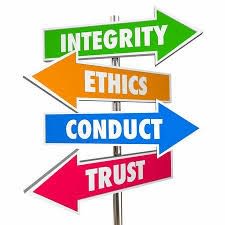
(123RF, 2019)
(123RF, 2019)
Elements required for the Reference List entry
- creator's name (author, artist, photographer etc.)
- date the work was published or created
- title of the work
- place of publication
- publisher
- type of material (for photographs, charts, online images)
- website address and access date
- name of the institution or museum where the work is located (for artworks and museum exhibits)
- dimensions of the work (for artworks)
Reference
123RF. (2019). Morals stock vectors, clipart & illustrations [Image]. https://www.123rf.com/clipart-vector/morals.html?sti=loanf8ojrsrk545axg
Website
Note: IF there isn’t a date available then use (n.d.) for no date
Example sentence with citation
According to their website, the Tertiary Education Quality and Standards Agency (TEQSA) is ‘Australia’s independent national quality assurance and regulatory agent for higher education’ (TEQSA, 2017).
Elements required for the Reference List entry
- Author(s) or Organization
- Date of Publication (Year, Month Day)
- Title of the Webpage (italicised)
- Title of the Website (if different from the webpage title)
- URL or DOI
Reference
Tertiary Education Quality & Standards Agency (TEQSA). (2017). Tertiary Education Quality & Standards Agency. https://www.teqsa.gov.au/
Helpful hints
- When you need to use an acronym, write the name in full the first time it is mentioned in your work, with the acronym in parentheses straight afterwards. The acronym can then be used from there on in your work.
Your turn
Document or Page Within a Website
Example sentence with citation
TEQSA’s website includes a page providing information on various aspects of academic integrity, for example a guidance note. The guidance note page defines academic integrity as ‘a commitment, even in the face of adversity, to six fundamental values: honesty, trust, fairness, respect, responsibility, and courage’ (TEQSA, 2019).
Elements required for the Reference List entry
- Author(s) or Organization
- Date of Publication
- Title of the Webpage (italicised)
- Name of the Website
- URL
Reference
Tertiary Education Quality & Standards Agency (TEQSA). (2019). Guidance note: Academic integrity, version 1.2. https://www.teqsa.gov.au/latest-news/publications/guidance-note-academic-integrity
Helpful hints
- Direct quotes should appear in your work exactly how they appear in the source. Because the font in our usual work is not italicised, if the source appears in italicised form (or bolded, capitals and so on) then we need to mention it in the in-text citation.
- If for some reason we italicise (bold, capitalise etc.) direct quotes in our own work, we must also mention that fact in the in-text citation. For example: (TEQSA 2019, my italics).
- The next section provides a UTAS-specific example of a document or page within a website, specifically, a learning module published in MyLO.
Your turn
Please go to https://www.integrity.tas.gov.au/publications/general-resources/brochures
This is a page within the Integrity Commission Tasmania website in the previous section.
Is this the correct way to reference the page?
Integrity Commission Tasmania n.d., Brochures, Integrity Commission Tasmania, viewed [day] [month], [year], <https://www.integrity.tas.gov.au/publications/general-resources/brochures>.
Document or Page Within a Website (UTAS example)
MyLO and other UTAS teaching and learning sites example
Example sentence with citation
As new technologies allow for more and more communication between people, so the need for understanding communication becomes more important (University College, 2020).
Elements required for the Reference List entry
- Author(s) or Organization
- Date of Publication
- Title of the Document or Webpage (italicised)
- Name of the Website (if different from the author or title of the document)
- URL
Reference
University College. (2020). Module 1, Welcome. Why do we communicate? Styles of communication and where we use them [Module]. University of Tasmania. https://utas.shorthandstories.com/2020_T1_ZAA135_01_prmeo/index.html
Helpful hints
- When you need to cite several different modules, all with the same author (in this case, University College), list them in year order.
- If the author and the year are the same for two or more entries, then order all those ones by the alphabetical order of the title. Add a, b, c (etc.) to the year in both the Reference List, and the corresponding in-text citation (eg 2020a, 2020b).
Blog | Listserv
Example sentence with citation
In her blog, Denise Pope (2014) discusses the feeling of despair many educators feel when they acknowledge the extent of cheating in schools.
Elements required for the Reference List entry
- Author(s) of the Blog Post
- Date of Publication (Year, Month, and Day)
- Title of the Blog Post (italicised)
- Name of the Blog (not italicised)
- URL
Reference
Pope, D. (2014, April 11). Academic integrity: Cheat or be cheated? Edutopia. https://www.edutopia.org/blog/academic-integrity-cheat-or-be-cheated-denise-pope
Your turn
You’ve just found a brilliant blog that provides you with just the sort of information you are looking for to include in your answer for an assessment task – in this case, someone else’s thoughts about reflective practice.
Book
Example sentence with citation
Hover et al. (2016) published a work relating to integrity in sports events titled Integrity & Sports Events: Management Summary: Fact Sheet 2016/2.
Elements required for the Reference List entry
- Author(s) or Editor(s)
- Date of Publication (Year)
- Title of the Book (italicised)
- Edition (if it's not the first edition)
- Publisher's Name
Reference
Hover, P., Dijk, B., Breedveld, K., & Van Ekeren, F. J. A. (2016). Integrity & sports events: Management summary: Fact sheet 2016/2. Muller Institute, Utrecht University.
Helpful hints
- Use ‘et al.’ in-text (which means ‘and others’) when there are more than two authors to the material utilised. All names should be included in the Reference List entry. It there are three or fewer authors, all names are included in both the text or in-text citation and in the Reference List.
- Use an ampersand (&) rather than ‘and’ when citing two or more authors.
Edited Book/Anthology
Example sentence with citation
Academic integrity in research is a standard topic in research handbooks, such as the Sage Handbook of Qualitative Research, edited by Norman K. Denzin & Yvonna S. Lincoln (2018).
Elements required for the Reference List entry
- Editor/s (family name then initials)
- Year of publication
- Title of the book in italics
- Publisher
- Place of publication
Reference
Denzin, N. K., & Lincoln, Y. S. (Eds.). (2018). The Sage handbook of qualitative research. Sage.
Helpful hints
- The first time you mention an author in your work write their names out in full.
- See below for when dealing with different editions.
Edited Book/Anthology
Example sentence with citation
Academic integrity in research is a standard topic in research handbooks, such as the Sage Handbook of Qualitative Research, edited by Norman K. Denzin & Yvonna S. Lincoln (2018).
Elements required for the Reference List entry
- Editor/s (family name then initials)
- Year of publication
- Title of the book in italics
- Publisher
Reference
Denzin, N. K., & Lincoln, Y. S. (2018). The Sage handbook of qualitative research. Sage.
Helpful hints
- The first time you mention an author in your work write their names out in full.
- See below for when dealing with different editions.
Book with more than one Edition
‘Integrity’, suggests Cole (2013, p. 94), ‘is the other main contributor to referent power’.
Elements required for the Reference List entry
- Author/s (family name then initials)
- Year of publication
- Title of the book in italics
- Number of edition (eg 2nd) – do not superscript the ordinals (st, nd, rd, th). Some programs automatically superscript ordinals, so you need to stay vigilant
- Add ‘edn’
- Publisher
Reference
Cole, K 2013, Management theory and practice, 5th edn, Pearson, Frenchs Forest.
Helpful hint
- Sometimes amendments are made to books and other publications, which are then re-published. These are known as new editions. This is why it is necessary to note the edition number, because what you might be citing in one edition might not actually appear in another edition, or might be on a different page number.
- If you directly quote or paraphrase in-text from any source, provide the page number/s in the in-text citation.
Handbook / Manual / Guidebook
Elements required for the Reference List entry (the same as for a book)
- Author/s (family name then initials) or organisation
- Year of publication
- Title of the book in italics
- Publisher
- Place of publication
Reference
Austen, K., Barwick, J., Foster-Davies, M., Phillips, B., & Bedloe, J. (2020). Community Development in Action. Neighbourhood Houses Tasmania, Tasmanian Government.
Dictionary or Encyclopaedia
Elements required for the Reference List entry (the same as for a book)
- Author(s) of the Entry: If available, start with the author's last name, followed by initials. If no author is identified, the citation begins with the title of the entry.
- Year of Publication
- Title of the Entry
- Title of the Dictionary or Encyclopaedia
- Publisher
- DOI or URL
Example sentence with citation
According to Macquarie Dictionary (2020, online), ‘empathy’ is defined as….”
Reference
For an online dictionary, you would add the URL at the end in the reference list. Here's an example:
Merriam-Webster. (n.d.). Empathy. In Merriam-Webster.com dictionary. Retrieved [date of access], from https://www.merriam-webster.com/dictionary/empathy
Government Publications (Legislation, Bills and Acts)
For print publications, you will need the following information:
- Author/s or name of government department
- Year of publication
- Title of the book in italics
- Publisher
If online:
- Provide the direct URL
For example:
United States Department of Health and Human Services. (2018). Physical activity guidelines for Americans (2nd ed.). U.S. Government Printing Office.
Documents produced by a government agency – no author and the agency is not the publisher:
- Author: Start with the name of the government agency. If the document is produced by a specific branch or division, that is included as part of the author element, not in parentheses. The structure is: Government Name. Agency Name. Division Nam
- Year of publication
- Title of the document in italics
- Publisher
- Place of publication
If online
- <URL>
Example:
Commonwealth legislation:
Disability Discrimination Act 1992 (Cth) s 5. https://www.legislation.gov
State legislation:
Public Health Act 2016 (WA) s 157. https://www.legislation.wa.gov.au/legislation/statutes.nsf/main_mrtitle_13577_homepage.html
Report / Annual report / Corporate plan
Example sentence with citation
In its most recent Annual Report, the Australian Securities & Investments Commission (2022) identifies that it has been instrumental in having fifty-nine ‘instances of potentially misleading or deceptive promotional material withdrawn or amended’ (p. 31).
When citing annual reports or corporate plans in APA 7th edition, the following guidelines should be followed:
- Author: The author is usually the company or organization that produced the report. Use the full name of the organization, not abbreviations.
- Year of Publication: Include the year of publication in parentheses.
- Title of the Report: Provide the full title of the report as it appears on the document. The title should be in italics.
- Publisher: The author and publisher are often the same for corporate documents like annual reports, so you do not need to repeat the publisher's name.
- URL (if applicable): If the report was accessed online, include the URL where the document can be found.
Referencing if corporate author (no author shown): example:
Australian Securities & Investments Commission. (2022). Annual report 2020-21. Retrieved October 11, 2022, from https://download.asic.gov.au/media/2aaomxuz/asic-annual-report-2020-21-full-1.pdf
Academic Journal
Example sentence with citation
Solmon (2018) suggests that there is widespread cheating in academic settings, with recently-available technology compounding the problem (p. 314).
Elements required for the Reference List entry
- Author(s): List the last name and initials of the author(s). If there are multiple authors, use an ampersand (&) before the last author's name.
- Year of Publication
- Title of the Article
- Title of the Journal
- Volume Number, italised
- Issue Number (if available)
- Page Range
- DOI or URL (if available): If the article has a DOI (Digital Object Identifier), include it at the end of the citation. If there is no DOI but the article was accessed online, provide the direct URL of the article.
Reference
Solmon, M. A. (2018). Promoting academic integrity in the context of 21st century technology. Kinesiology Review, 7(4), 314-321.
Helpful hint
If you directly quote or paraphrase in-text, provide the page number/s in the in-text citation.
Your turn
You are inserting the following quote from page 73 of a journal article by L. Treviño and M. Brown (see the reference below):
‘Research suggests that formal ethics and legal compliance programs can have a positive impact’
Reference source:
Treviño, L. K., & Brown, M. E. (2004). Managing to be ethical: Debunking five business ethics myths. Academy of Management Executive, 18(2), 69-81.
Trade Journal | Magazine | Newspaper
Example sentence with citation
In the opinion of Sean Ford (2019, p. 10), the increasing use of language that sounds positive but might not mean anything at all is affecting our ability to communicate.
Elements required for the Reference List entry
- Author(s)
- Year of Publication
- Title of the Article
- Title of the Trade Journal/Magazine/Newspaper
- Day and Month of Publication
- Page Number(s)
Reference
Ford, S. (2019, August 29). When the vernacular is not quite oracular. Advocate, p. 10.
Helpful hints
If the article is anonymous, you would typically list the title of the article first, and then the date, and it does need to be included in the reference list.
If the article is online, you don't need to include the word "online" in the citation; instead, you provide the URL after the date.
Even if the article is anonymous, an entry is required in the reference list. You would start the entry with the title of the article since there's no author.
Conference Paper
Example sentence with citation
As Marshall (2011) considers, good analysis is reflective.
Elements required for the Reference List entry
- Author's last name and initials
- Year of publication
- Title of the paper (in plain text within quotation marks)
- Title of the conference proceedings (in italics)
- If available, the name of the conference as well as its location and date
- If published in conference proceedings, include the publisher and the place of publication
- Volume and issue number (if applicable)
- Page number(s)
- For an electronic source, include the DOI (Digital Object Identifier) or URL, and the date of access is only necessary if the source is likely to change over time
Reference
Marshall, H. (2011). Good qualitative analysis – examiners' views. Proceedings of the 2011 TASA Conference: Local Lives Global Networks (pp. 1-13). The Australian Sociological Association. https://doi.org/xxxxxx
In APA 7th edition, personal communications such as emails, which are not recoverable by the reader, are cited only in the text and are not included in the reference list.
Example sentence with citation
In-text citation:
According to H. Marshall (personal communication, April 1, 2021), ...
Or …….his words paraphrased (H. Marshall, personal communication, April 1, 2021).
Reference
Remember, this type of source is not included in the reference list because it is not accessible to the audience of your paper.
Personal Communication
Example sentence with citation
It was suggested that ‘magpieing’, or adding to our vocabulary for our own use new words or turns of phrase from someone else’s work, is not plagiarism as long as we are not claiming what was expressed by the words or phrases as our own idea (C. Smith 2019, pers. comm., 5 September). She suggested that if we are in doubt, then reference.
Or:
In a lecture by C. Smith (personal communication, September 5, 2019), it was suggested…
Reference
Remember, this type of source is not included in the reference list because it is not accessible to the audience of your paper.
Helpful hints
- While no entry is required in the Reference List, make sure as much identifying information as possible is included either in the in-text citation or in the text – see the examples.
- Personal Communications can include such items as conversations (with teachers, tutors, coaches, peers, and others), interviews, phone calls, letters, and public lectures.
Brochure | Leaflet | Pamphlet
Example sentence with citation
An example of a leaflet is the recent information page, It all starts with you, provided by University College (2019?).
Elements required for the Reference List entry
- Author(s) or Organization Name
- Year of Publication
- Title of the Brochure/Pamphlet (italised)
- Description of the Document Type: This could be a note such as "Brochure" or "Pamphlet."
- Publisher: If available, include the name of the publisher.
- Place of Publication: This is less commonly included for brochures and is often omitted, especially if the publication is primarily distributed electronically or the place of publication is not clear.
For an electronic source:
- Date Viewed: Include the date when the brochure or pamphlet was accessed.
- URL: Provide the direct URL where the brochure or pamphlet can be found.
Reference
University College. (2019?). It all starts with you. University of Tasmania.
Helpful hint
Put a question mark directly after the year of publication if you are not quite sure of the year. Many brochures will not show a date so your best estimate is acceptable. If you cannot estimate, then use the abbreviation ‘n.d.’ (which means ‘no date’) rather than the year of estimated publication.
App
Example sentence with citation
The Integrity App allows for self-evaluation of an integrity program, and after the app user answers a questionnaire access is provided to resources to help improve the program (Alliance for Integrity 2018).
Elements required for the Reference List entry
- Owner or Developer of the App
- Year of Publication or Last Update
- Title of the App (in italics)
- Version Number
- Format (usually noted as "Mobile app")
- Date Viewed or Accessed (if downloaded)
- URL (if available)
Reference
Alliance for Integrity. (2018). Integrity app (Version 0.0.3) [Mobile app]. Retrieved May 7, 2020, from https://play.google.com/store/apps/details?id=com.theintegrityapp.app&hl=en
Secondary Source
A secondary source discusses information originally presented elsewhere. Unlike primary sources, which provide direct evidence or firsthand accounts, a secondary source offer a layer of interpretation or critique of primary sources.
When citing a secondary source, you only include the source you actually read in your reference list. In your text, you make it clear that your information is coming from a secondary source.
Example sentence with citation
Cosgrove's observation that companies fail due to "a failure in integrity by the leaders" (as cited in Cole, 2013, p. 176) highlights...
Elements required for the Reference List entry
These will be the same descriptive elements as whichever source type you are referencing.
Reference
Cole, K. (2013). Management theory and practice (5th ed.). Pearson.
Helpful hints
- Note the words ‘cited in’ have been added to the in-text citation to indicate that although it was Cosgrove who was the author, it was Cole who cited Cosgrove in their work.
- It is best if you can find and cite the original source of the text (in this example, Cosgrove). However, sometimes this is not possible, therefore you must cite the secondary source and reference it to the author/organisation who has done the citing.
- If you directly quote or paraphrase in-text, provide the page number/s in the in-text citation.

FINDING THE REQUIRED INFORMATION: THE BASIC DESCRIPTIVE ELEMENTS OF A REFERENCE
As you will note from each of the source types above, there are several basic pieces of information (descriptive elements) you will be required to include for your referencing, whichever referencing style you are required to use.
It is best to note these elements at the time you access the source, especially if you are going to utilise any of its contents in your own work. Not all the elements will be utilised in every reference, but most will.
- Author Information: Use the author's last name and initials. If no author is available, the organization's name is used.
- Year of Publication: Include the year of publication, or for websites, the "last updated" date.
- Title of the Work: The title should be in italics for books and reports, but not for articles or chapters within edited books.
- Edited Books and Anthologies: Include the chapter title, page range, edition number, and editor names. The edition number is abbreviated (e.g., 5th ed.).
- Publisher Name: Include the publisher's name except for periodicals.
- Electronic Sources: Include the URL or DOI. The site owner is not typically necessary unless it is different from the author and relevant to the context of your citation. The date viewed is included only if the source material is likely to change over time.
- Page Numbers: It's important to note the specific pages you are referencing, especially for direct quotations or specific points within a source.
GENERAL RULES FOR IN-TEXT CITATIONS
- When directly quoting or paraphrasing another person's or organization's work (known as 'in-text'), include the relevant page number(s) in the in-text citation (note: many internet sources do not have page numbers).
- Direct quotes should be enclosed in double quotation marks.
- Capitalise the major words in titles when they appear in your text, but use sentence case in the Reference List
- The same in-text citation must be used every time you refer to the same source for the same knowledge or ideas, even if you need to do it multiple times (page numbers might differ).
- However, the corresponding full reference only needs to appear once in the Reference List.


Important Notes To Help With Citing and Referencing
You may have noticed that there seems to be a logical system to the references. Well, there is. Each type of source has a set formula for referencing.
Harvard is a version of what is known as the Author-Date system, that is, the references all start with the name of the author, followed by the date of publication or posting, the name of the work, where it was published, and by whom (and Internet details, if applicable).
For detailed information, please see the Harvard referencing site.
There are, however, some general rules. The following is a guide to them.
General Rules For In-text Citation
- If you directly quote or paraphrase another person’s or organisation’s work in your own work (known as ‘in-text’), provide the relevant page number/s in the in-text citation (note: many Internet sources do not have page numbers)
- Direct quotes are enclosed by single quotation marks (inverted commas), not double ones
A direct quote is when you reproduce exactly (words, punctuation, etc.) material taken directly from any other author’s work (including your own).
- If you directly quote 30 or more words (about four lines), it is called a block quote:
- Start on a new line
- Indent the block about 5 spaces
- Decrease the font size by 1 point
- Do not use quotation marks
- The in-text citation appears after the final full stop but on the same line (if possible)
- Capitalise the main words in titles when they appear in your work, but use sentence case in the Reference List (that is, a capital letter for the first word, and only capitalise proper nouns in the rest of the title) – this includes for the second part of a title (sometimes titles have two parts: the main part, then a second part, usually after a colon)
- The same in-text citation must be inserted every time you refer to the same source of the same knowledge or ideas, even if you need to do it multiple times (page numbers might differ)
- However, the corresponding full reference only needs to appear once in the Reference List
General Rules For The Reference List
- The Reference List must be on a new page at the end of your work
- Every line justifies to the left (no indentation is required)
- Put it in single line spacing
- Leave one line between each entry
- Use commas rather than full stops between descriptive elements
- Do not have a comma before the date of publication
Author order
- The Reference List is in author-alphabetical order (not in the order of appearance in your work)
- When citing two or more sources from the same author:
- First, order those references by year published (from earliest to latest)
- If the sources were published in the same year, next order them alphabetically by the title. Then add a, b, c (etc.) to the year in both the Reference List, and the corresponding in-text citation (eg 2020a, 2020b). This will be important when citing weekly modules from specific course units, such as the MyLO modules exampled above
- For second and subsequent entries by the same author/s, (after ensuring you have them in the correct year/title order), replace the name/s with five hyphens: -----
- If you utilise multiple citations to support the one concept, then the citations appear in the in-text citation in chronological order, the earliest first. For example: (Hover et. al 2016; Christians 2018)
- For correct authorship details for pages or sections of a website, you might need to go back to the site’s Home page
Year of publication
- If you cannot find a year on a website, utilise the ‘last updated’ year (often found at the foot of the page)
- If there is no year of publication shown at all, whether on a website or any other source, use ‘n.d.’ (no date)
- In some cases (for example, brochures, or very old texts) you can estimate the year, but add a question mark (eg 2019?) to show that it is an estimate
Titles of texts/names of websites etc.
- Use sentence case (that is, a capital letter for the first word and then only for proper nouns) for titles or names of websites
Viewed date (for online sources)
- References for online sources need to show the viewed date (that is, the date you actually looked at the site). This includes for books, journals, pamphlets, newspapers etc. as well as for general websites and pages within websites
- Why is this important? Websites can appear and disappear, and contents can change
- This is illustrated by the image shown under ‘Images | Pictures’ above – the image was on the site shown in the reference on 6 September 2019 when it was first viewed, but had disappeared by April 2020, when this module was created
- When you reference audio material (eg radio programs, records) replace the word ‘viewed’ [date] with the word ‘accessed’ in the reference
- When you reference apps: if you simply look at the app and its descriptor, then use the word ‘viewed’. If you actually downloaded it and then referenced from it, use the word ‘accessed’
The URL (Uniform Resource Locator, colloquially termed a web address)
- References for online sources also need to show the URL or web address
- URLs are enclosed in angle brackets <> – this is to set them off against the other referencing text and ensure punctuation marks (such as full stops) are not taken as being part of the URL
- If you must break a URL, do so straight after a forward slash /
- They are case sensitive
- The title of the text (or name of the site, etc.) is italicised or enclosed in single inverted commas, depending on the type of reference (eg book titles are italicised; journal article titles are enclosed in single inverted commas) – please check the examples


Recap
Referencing is an important part of any academic work. Referencing is correctly and fully acknowledging where we obtained other peoples’ words, knowledge and ideas to use or refer to in our own work.
Utilising referencing not only shows courtesy, but it increases our own credibility as a reliable author, it provides a way for ourselves and our audience (readers, mostly) to find the source, and it helps observe copyright and avoid possible breaches of academic integrity.
There are many different variations (possibly thousands) of the few basic styles of referencing. As of 2024 University College utilises APA7, a widely used and recognised referencing style.
While there are a lot of protocols (rules) around referencing, and how to reference material from the many different places (sources) we might find it, there are also some basic formulae, and once we have the basics down pat (from practice, usually), the whole thing becomes much more easily achieved.


Glossary of Terms used in Referencing
Here are some of the common terms used in relation to referencing:
Bibliography:
a list of documents consulted but not necessarily referred to in a specific essay or assignment. A bibliography can also be a comprehensive list of works on a specific subject, for example, The Bibliography of Bioethics.
Even though APA7 does not normally utilise bibliographies, when researching a topic it is a good idea to prepare one for yourself and then those items you actually refer to in your work can go into the work’s Reference List.
Citation or Referencing style:
the method used to format citations. Some commonly used formats are Harvard, MLA, Chicago, APA and Vancouver. University College utilises Harvard as shown on the UTAS Library website.
Descriptive elements:
the necessary parts of a reference. A few examples of these elements are: author, title, edition, date of publication, internet address, etc.
Digital Object Identifier (doi):
a numbered tag used to identify digital sources such as journal articles.
Electronic:
a generic term used to describe documents available from the Internet or from databases or published in a digitised format.
Ed.:
is the abbreviation in the APA style for ‘edition’ (e.g. Editor, E. E. (Ed.). (Year). Title of the book. Publisher)
et al.:
from the Latin et alia, meaning ‘and others’.
In-text citation:
a method of signalling to the reader that the words or ideas quoted or referred to are not your own. The method for acknowledging the source document will vary according to the citation style you are using.
Peer-review:
a process used to check the accuracy and author of a publication. Used in academic publishing, the author’s draft is sent by an editor (usually anonymously) to experts in the field of study who suggest amendments. This is seen as a type of quality control and is distinctly different from traditional publishing or web publishing where anyone can publish.
It is also a good practise for students and academics.
Reference:
an accurate and complete description of a document. A document may be a book, a journal article, a video, an email, or an internet site, etc. The reference should include sufficient descriptive elements to identify and locate the document.
Reference List:
a list of all the documents you have referred to in your assignment or project. It is usually included at the end, on a fresh page. It may be arranged alphabetically or numerically and formatted according to one of the citation styles. APA7 arranges reference lists alphabetically.
sic:
from the Latin meaning ‘so, thus’. It is used after a quoted or copied word that has been written exactly as the original. The term usually highlights a misspelling.
The above glossary is adapted from the Institute of Education Library (London) (2020).


Reference List
123RF. (2019). Morals stock vectors, clipart & illustrations. https://www.123rf.com/clipart-vector/morals.html?sti=loanf8ojrsrk545axg|
Alliance for Integrity. (2018). Integrity app (Version 0.0.3) [Mobile app]. https://play.google.com/store/apps/details?id=com.theintegrityapp.app&hl=en
Christians, C. G. (2018). Ethics and politics in qualitative research. In N. K. Denzin & Y. S. Lincoln (Eds.), The Sage handbook of qualitative research (5th ed., pp. 66-82). Sage.
Cole, K. (2013). Management theory and practice (5th ed.). Pearson.
Denzin, N. K., & Lincoln, Y. S. (Eds.). (2018). The Sage handbook of qualitative research (5th ed.). Sage.
Ford, S. (2019, August 29). When the vernacular is not quite oracular. Advocate, 10.
Hover, P., Dijk, B., Breedveld, K., & van Ekeren, F. J. A. (2016). Integrity & sports events: Management summary: Fact sheet 2016/2. Mulier Institute, Utrecht University.
Institute of Education Library. (2020). Referencing with Harvard: Terms. https://libguides.ioe.ac.uk/c.php?g=482485&p=3298734
Marshall, H. (2011). ‘Good’ qualitative analysis – examiners’ views. Proceedings of the 2011 TASA Conference: Local Lives Global Networks, Newcastle, Australia, 28 November - 1 December, 2011 (pp. 1-13).
Pope, D. (2014, April 11). Academic integrity: Cheat or be cheated? [Blog post]. Edutopia. https://www.edutopia.org/blog/academic-integrity-cheat-or-be-cheated-denise-pope
Smith, C. (2019, September 6). [Email to the author].
Snooks & Co. (2002). Style manual for authors, editors and printers (6th ed.). John Wiley & Sons.
Solomon, M. A. (2018). Promoting academic integrity in the context of 21st-century technology. Kinesiology Review, 7(4), 314-321.
Stauber, S. (2013, September 4). Academic integrity [Video]. YouTube. https://www.youtube.com/watch?v=2wvXEAO4Q44
Tertiary Education Quality and Standards Agency. (2017). Tertiary Education Quality and Standards Agency. https://www.teqsa.gov.au/
Tertiary Education Quality and Standards Agency. (2019). Guidance note: Academic integrity (Version 1.2). https://www.teqsa.gov.au/latest-news/publications/guidance-note-academic-integrity
Treviño, L. K., & Brown, M. E. (2004). Managing to be ethical: Debunking five business ethics myths. Academy of Management Executive, 18(2), 69-81.
University College. (2019?). It all starts with you [Leaflet]. University of Tasmania.
University College. (2020). Module 1, Welcome. Why do we communicate? Styles of communication and where we use them. ZAA135 Professional Communication [Module]. University of Tasmania. https://utas.shorthandstories.com/2020_T1_ZAA135_01_prmeo/index.html
University of Southern Queensland. (n.d.). 1. Overview of APA 7th edition. APA 7th referencing style guide. https://usq.pressbooks.pub/apa7/chapter/1/
University of Tasmania Library. (2019). Harvard referencing. University of Tasmania.
Experiential Education Team, updated 2024
This module provides examples of how to how to acknowledge correctly (in an in-text citation and in a Reference List) your source each time that you utilise other peoples’ words, knowledge and ideas in your own work. It explains the referencing style (APA7) that should be used in the University College. It also lists the various descriptive elements that are required for each source type, and gives handy hints along the way.
 Built with Shorthand